REVIEW · GLASGOW
Glasgow Ghost Hunt: The Soul That Got Away Exploration Game
Book on Viator →Operated by Questo · Bookable on Viator
A Glasgow ghost hunt sounds fun, and this one is actually practical. It uses an interactive app with directions, so you’re not wandering around guessing, and you get a clear hit list of stops like Glasgow Central and George Square. The main downside is that if the app sign-in goes sideways, you may lose momentum fast.
I also like that the pace is fully yours. You can start (and take a break) when you want, and the route stays out in the open air, which makes it easy to dip in and out without feeling trapped. Still, it’s more of a history-and-puzzles walk with ghost flavor than a guided scare-fest, so go in expecting questions and clues more than spooky storytelling.
In This Review
- Key things to know before you play
- Price and time: what $6 really buys in Glasgow
- Your route starts at Glasgow Central Station (and right away, you’re solving)
- The Lighthouse of Glasgow: city views plus a hidden checkpoint
- House of Frasers: shopping with an afterlife twist
- Tron Theatre: where performance meets your next movement task
- Merchant City: history, street energy, and clue-finding in plain sight
- Buchanan Street to George Square: from upmarket shopping to civic monuments
- Finishing at George Square: statues and the final question
- How the self-guided format changes your experience (for better and worse)
- What I think works best for you (and who might bounce)
- My take on the value: big landmarks at scavenger-hunt prices
- Should you book Glasgow Ghost Hunt: The Soul That Got Away?
- FAQ
- Is this tour self-guided or led by a guide?
- How long does the experience take?
- Where do I start and finish?
- What is included in the price?
- Is it flexible in timing?
- What language is the tour in?
- Is it indoors or outdoors?
- Is there a group size limit?
- What if the app won’t load or sign-in is difficult?
- What’s the cancellation policy?
Key things to know before you play

- Smartphone directions keep you on course between checkpoints across central Glasgow
- Start any time after booking, with flexible start-and-stop play
- Landmarks, not detours: Central Station, the Lighthouse, House of Frasers, Tron Theatre, and more
- Self-guided format means no live guide, no entry tickets, and fewer waiting lines
- Cheap group price at about $6 per person for roughly 90 minutes
- App reliability matters—plan a little time to get signed in before you begin
Price and time: what $6 really buys in Glasgow
This is one of those deals that feels almost too good for central Glasgow sightseeing. At $6 per person for about 1 hour 30 minutes, you’re paying for an app-driven route, clue prompts, and a self-guided structure that nudges you toward major sights without paying attraction admission.
The tour is designed to be mobile-first. You’ll receive a mobile ticket, and the experience is played using the app, so your main “cost” is attention and battery life. Bring a charged phone and a cable if you can—Glasgow walks can run long if you stop for photos.
Timing is also unusually convenient. Once you book, you can play anytime without needing to reschedule, and the stated hours are essentially open all day. That’s handy if your day includes other plans like shows, shopping, or a late lunch.
Other ghost and haunted tours we've reviewed in Glasgow


Your route starts at Glasgow Central Station (and right away, you’re solving)
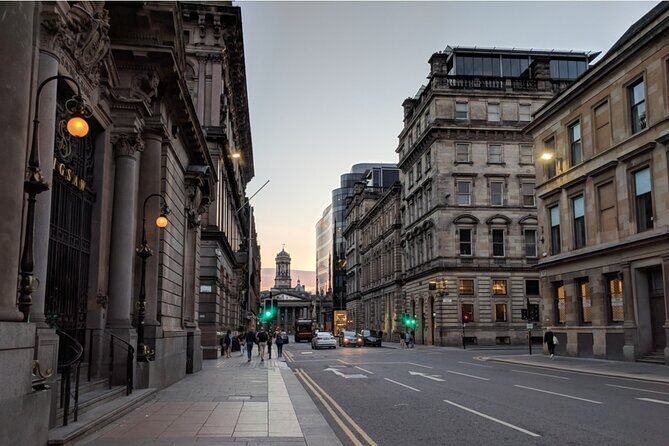
You begin at Glasgow Central on Gordon Street. It’s one of the city’s big rail terminals with a striking glass roof and classic Victorian architecture, and it also has a layered story that fits the ghost-hunt vibe.
Right away, the game pushes you to look. Your first task has you scanning the surroundings for a missing clue, with hints about older uses tied to vaults, catacombs, and disused platforms below the station. Even before the game gets spooky, it’s training you to slow down and read the place.
Practical tip: the station can be busy, so take a moment to get oriented and to open the app before you start moving. If your sign-in takes time, do it while you’re still standing at the entrance area.
The Lighthouse of Glasgow: city views plus a hidden checkpoint
Next you head to the Lighthouse of Glasgow, Scotland’s Centre for Design and Architecture. This stop works because the building is described as a kind of “beacon” for creative industries, and it also gives you the chance to aim your eyes across the cityscape from a high vantage point.
In the game, the Lighthouse is also a place with a “not-very-light secret.” That means you’re not just passing by. You’ll be looking around for another checkpoint and answering the prompt that moves you to the next stage.
What I like about this stop: it breaks the pattern. After starting in a transport landmark, you shift to a cultural/design building where the focus is still on scanning your surroundings—not just walking.
One possible friction point: if you’re expecting a traditional guided ghost story narrated to you at each location, this won’t match that style. The Lighthouse checkpoint is more about observation and completing the game tasks than listening to a host.
House of Frasers: shopping with an afterlife twist
The tour then takes you to House of Frasers, a major UK department store. The game frames it as a place with a long origin story, starting as a small drapery store founded by Hugh Fraser and James Arthur in 1849 and expanding into a wider chain.
The clue here is built around the idea of “afterlife tastes.” You’ll be answering questions while you’re in or near the shopping setting, so you can make this part work whether you’re actively browsing or simply moving through quickly to solve the prompt.
This stop is useful for two reasons:
- It keeps you in central Glasgow, where you’re never far from food and bathrooms.
- It gives the experience a lighter mood, since the theme becomes playful rather than purely grim.
If you’re playing with kids, this segment tends to be the kind of challenge that feels like a game first and a ghost tour second.
Tron Theatre: where performance meets your next movement task
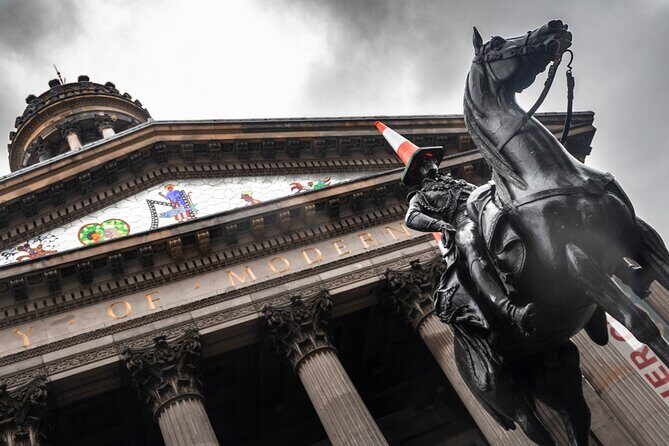
As you reach the mid-point, you’re guided toward the Tron Theatre, described as a major force in Glasgow’s cultural scene for over twenty years. The game portrays its shift from a simpler theatre club into a multi-use venue for new writing, dance, comedy, and music.
In gameplay terms, you’re told to warm up your voice and “dance through the surroundings,” then move to the next checkpoint. That phrasing matters because it signals how the game expects you to interact with the space: look for prompts in the right areas, then move on when you’ve solved.
Why this stop is valuable: it adds cultural texture. You’re not only taking in big famous monuments—you’re also cutting through a working arts area that feels like Glasgow’s everyday life.
A few more Glasgow tours and experiences worth a look

Merchant City: history, street energy, and clue-finding in plain sight
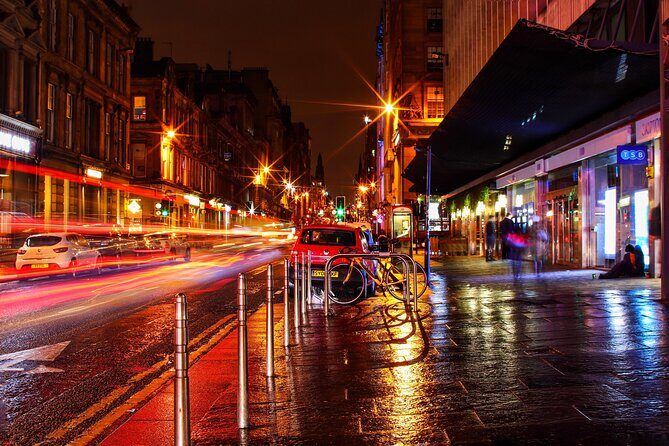
After the Tron Theatre, the route pushes you toward the Merchant City, the historic eastern backbone of Glasgow. Here, the story line is set in the mid-1750s, with residents trading with “tobacco lords” connected to shipping and goods like tobacco, sugar, and tea.
This is also where the game’s tone often changes from building-to-building tasks into area scanning. You’ll be asked to find answers to “unspoken truths” while looking around a district known today for bars, restaurants, boutiques, galleries, and festival activity.
A quick reality check: the ghost theme is lighter here. Even when the location is steeped in trade history, the experience is still mostly you walking, reading cues, and solving puzzles rather than following a scripted haunted tale.
Still, it’s a strong fit for anyone who wants a route that makes them walk neighborhoods they might not choose if they were only chasing the biggest photo stops.
Buchanan Street to George Square: from upmarket shopping to civic monuments
Next, you head to Buchanan Street, Glasgow’s main pedestrian boulevard, lined with architectural details and shopping. The game ties the street’s founding to 1777, named after wealthy tobacco lord Andrew Buchanan—and it hints at a story twist when ownership changed.
You’re prompted to answer questions as you cross the street and notice details along the way. This is another “slow down” moment, and it’s a good place to keep the game going because you’re moving through an area where it’s easy to stop, check your phone, then continue.
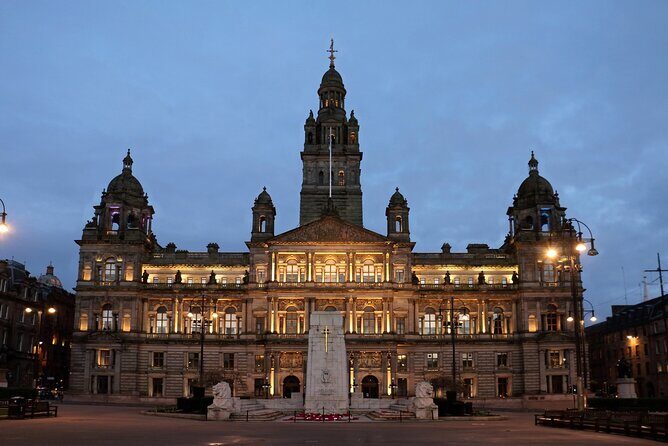
Then the route rises to the civic heart: George Square and the City Chambers experience. The game points you to the focal point of the square and highlights a statue known locally as Glasgow’s own Statue of Liberty. It also mentions a major interior moment: the Banqueting Hall, where Nelson Mandela received the Freedom of the City award in 1993.
If you like history you can see with your own eyes, this part is a big pay-off. Even if you only have time for a quick look inside the main flow of the building, the surrounding spaces and stairway scale make the city feel grand.
Finishing at George Square: statues and the final question
Your final checkpoint returns to George Square, described as one of the city’s best-loved civic spaces. The game points out an important collection of statues and monuments, including ones dedicated to Robert Burns, James Watt, Sir Robert Peel, and Sir Walter Scott.
This ending matters because it gives closure to the puzzle arc. You’re solving one last question that confirms you’ve reached the finish area, rather than just wandering off when the app says you’re done.
Where you finish: West George Street. It’s a handy end point if you want to keep exploring with dinner nearby or connect to public transport without a long backtrack.
How the self-guided format changes your experience (for better and worse)
This is a self-guided ghost hunt with an app. That’s a big deal for expectations. If you want a person in front of you telling stories, this won’t be that. If you’re the type who likes walking, reading, and solving, you’ll probably find it satisfying.
Here’s what you get with the self-guided model:
- Flexibility: start when you’re ready, pause, and continue at your own pace
- Less waiting: no guide schedule to match, and no attraction entry fees are required to complete the game
- Open-air walking: you can keep moving without committing to a long indoor block
Here’s what to watch:
- The app is the engine. If sign-in is frustrating or the clues don’t cooperate, you can lose time and motivation. One useful strategy is to get the app open and working before you’re halfway down the route.
- Some puzzle answers can feel strict. If you’re used to scavenger hunts where partial entry works, you may need to type exactly what the app expects.
What I think works best for you (and who might bounce)
This experience fits best if you like:
- A walkable central route through Glasgow landmarks
- Puzzles and Q&A as the core activity
- Getting your bearings fast in the city center
- A family-friendly structure where clues can be age-appropriate
It may not be your match if you’re expecting:
- Only ghost stories with heavy scares
- A game you can play without paying attention to the phone
- A route that feels fully polished if you run into tech issues
If you’re traveling with kids, it’s a strong option because the challenges can be fun and approachable. If your group is older and you still want to see the same sights, it can still work well—just expect that you’ll be doing more reading than listening.
My take on the value: big landmarks at scavenger-hunt prices
At around $6 per person, this is a value play. You’re basically buying:
- A pre-built route through top central Glasgow highlights
- A guide-less structure that tells you where to go next
- A puzzle layer that turns sightseeing into a game
For comparison, paying for a traditional guided ghost walk usually costs more, and you often lose the flexibility. This experience keeps the flexibility, and it adds the benefit of directions so you don’t waste time guessing streets.
Just remember the trade-off: you’re trusting your phone. If you’re the kind of traveler who hates tech, you may find the experience frustrating instead of fun.
Should you book Glasgow Ghost Hunt: The Soul That Got Away?
Book it if you want a low-cost way to see Glasgow’s center with a built-in walking plan and puzzle prompts. It’s especially good for couples, small groups, and families who don’t mind using an app while moving through the city.
Skip it (or at least adjust expectations) if you mainly want a narrated ghost story and you don’t want to deal with app sign-in or clue entry. If you do book, show up with a charged phone and give yourself a couple minutes to get started without rushing.
FAQ
Is this tour self-guided or led by a guide?
It is self-guided. There is no physical tour guide, and you play using the smartphone exploration app.
How long does the experience take?
The tour lasts about 1 hour 30 minutes.
Where do I start and finish?
You start at Glasgow Central (Gordon St, Glasgow G1 3SL) and finish at West George Street (Glasgow G1 2AF).
What is included in the price?
You get the mobile ticket and access to the smartphone exploration app. Entry tickets to attractions are not needed to complete the tour.
Is it flexible in timing?
Yes. You can play anytime after booking without rescheduling, and you can start or stop and take breaks at your own pace.
What language is the tour in?
The experience is offered in English.
Is it indoors or outdoors?
It’s self-guided and open air, so you’ll be walking outside between stops.
Is there a group size limit?
It’s a private activity for your group. If your group is larger than 15 people, you can book multiple times.
What if the app won’t load or sign-in is difficult?
The provided help guidance for app problems points you to contact [email protected] for assistance with access or sign-in issues.
What’s the cancellation policy?
You can cancel for free up to 24 hours in advance for a full refund. If you cancel less than 24 hours before the start time, you don’t get a refund.