REVIEW · GLASGOW
Glasgow Gin Tea Experience
Book on Viator →Operated by Red Bus Bistro Company Limited · Bookable on Viator
Glasgow is a city you can read fast. This tea-and-sightseeing ride is built for that, mixing afternoon tea with quick, memorable looks at the sights. You get a standout spread (warm scone with cream and jam, plus sandwiches, mini quiche, and petit fours) and you also get a useful “where am I” overview from a smart route through classic Glasgow landmarks.
The only catch: the name includes Gin, but alcohol availability can be limited, so don’t assume a full gin tasting is part of the deal.
The good news is that the pace works for almost everyone. You’ll be seated, fed, and able to compare neighborhoods as you move—plus there’s time to chat with your small group. One thing to plan for is that it’s not a deep guided walk with long stops. You’ll mostly get photo-ready views and short on/off moments.
In This Review
- Key highlights to know before you go
- A tea bus that actually helps you understand Glasgow
- What you eat on the Glasgow Gin Tea Experience (and what it’s worth)
- Getting on board: vintage bus energy, no toilet on the route
- Gallery of Modern Art to City Chambers: Glasgow’s public face
- Glasgow Cathedral and the Necropolis: medieval survival and Victorian drama
- Wellpark Brewery, Glasgow Tower, and Doulton Fountain: industry to pop spectacle
- People’s Palace to the river bridges: a smooth route with big views
- Finnieston Crane and the SEC area: engineering heritage with modern form
- Clydeside Distillery, Riverside Museum, and Tennent’s Bar: the food and culture zone
- Hunterian Art, University of Glasgow, Kelvingrove, and Mitchell Library: culture without the slog
- The pace and what you should do after
- Should you book the Glasgow Gin Tea Experience?
- FAQ
- FAQ
- How long is the Glasgow Gin Tea Experience?
- What’s included in the tea spread?
- Is there gin included as part of the experience?
- Are admission tickets provided for the stops?
- Where does the tour start?
- Is there a toilet on the bus?
Key highlights to know before you go
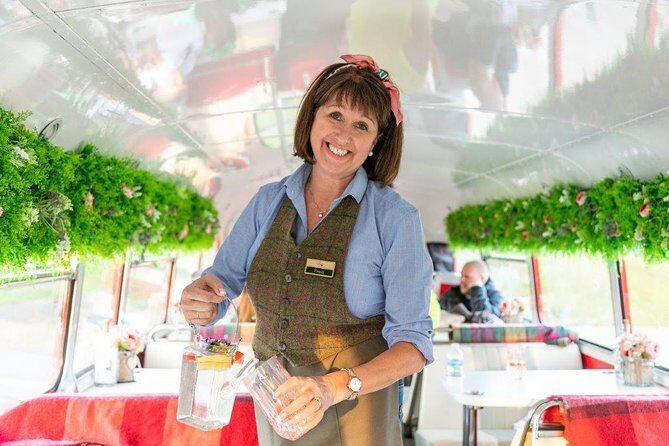
- A real tea spread: scone with cream and jam, sandwiches, warm mini quiche, petit fours, and unlimited tea/coffee
- Tiny group feel: capped at 15 travelers, so it’s easy to talk to people
- Great skyline and architecture shots: you’ll see Glasgow’s signature towers, bridges, and riverside landmarks
- Free entry locations: the stops include major sights where admission is listed as free for this experience
- Modern drink vibes, classic city views: local breweries, distilling history, and museum stops all fit together
- Not a full commentary tour: you’ll get interaction and tips, not a recorded or live narration the whole ride
A tea bus that actually helps you understand Glasgow
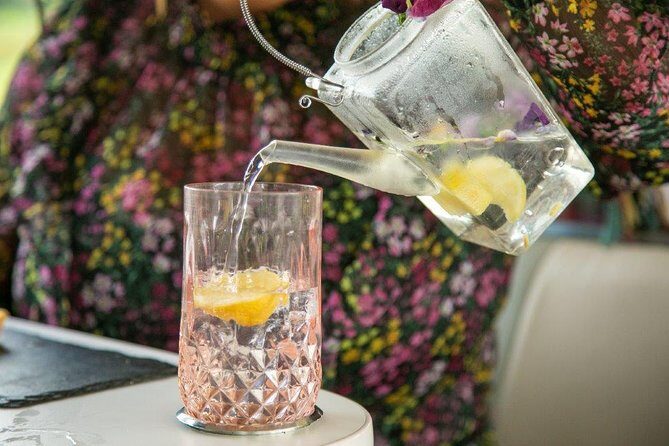
This is the kind of tour that makes sense on day one. Instead of forcing you to pick between museums, cathedrals, and craft-drink stops, the experience layers them in a single 1 hour 30 minute loop. I like that it gives you context fast: you see Glasgow as a mix of civic pride, heavy industry, and world-class culture—then you can decide what’s worth a second visit on your own.
You’re also not stuck staring out a bus window with nothing to do. The food is part of the experience, with a proper tea setup that helps you settle in. And because the group size is small, the social part isn’t awkward. People end up talking about where they’re from, what they’re interested in, and what to see next.
The other reason this format works is simple: you can photograph the city without negotiating foot traffic, crossings, and parking. Glasgow has plenty of walkable neighborhoods, but this route is set up for moving smoothly between them.
Other afternoon tea tours we've reviewed in Glasgow


What you eat on the Glasgow Gin Tea Experience (and what it’s worth)
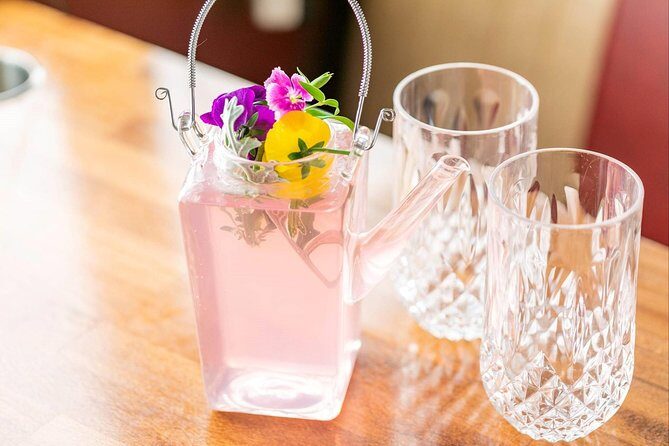
For the price you pay—about $69.31 per person—this experience earns value by including the food and drinks you’d otherwise budget separately. You get:
- a warm home baked scone with cream and jam (with strawberry garnish)
- handmade sandwich selections
- warm mini quiche
- unlimited tea and coffee
- a selection of petit fours
- coffee and/or tea again as part of the flow
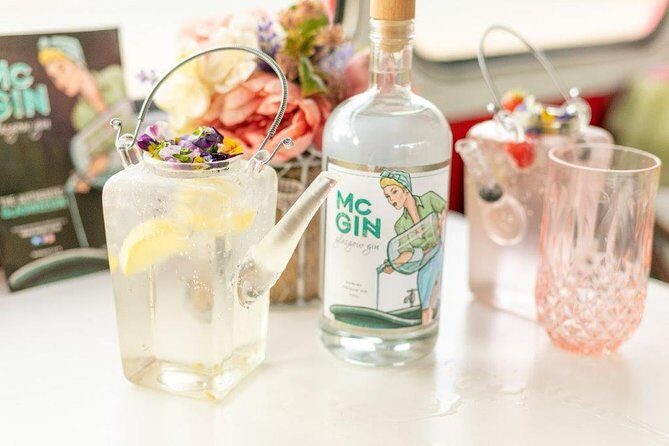
You’re also offered alcoholic beverages for purchase. Here’s the practical point: if you booked specifically for a gin moment, treat that as a bonus rather than a guaranteed “gin service.” One review complaint and the operator’s response line up on this: at times, alcohol service can be restricted by government rules, and customers are told ahead of time. So if you’re expecting gin to be poured, check what’s included on your exact date and whether anything is limited.
Even without alcohol, this is still a strong afternoon-tea-style offering. A standard tea experience in the UK can get pricey, and here you’re also getting a structured route past major sights. That’s how the math works.
Getting on board: vintage bus energy, no toilet on the route
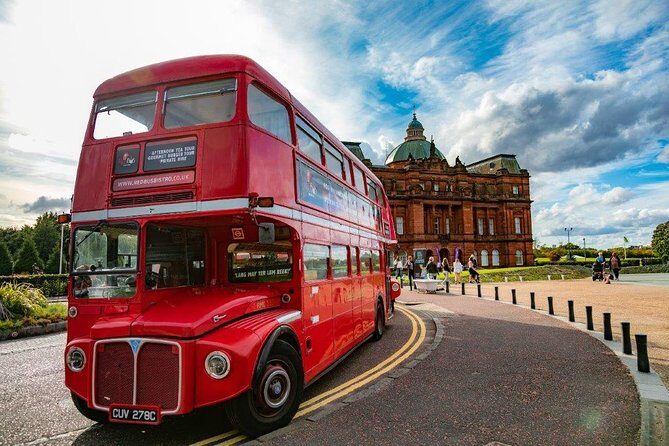
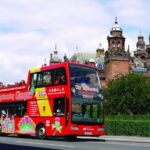
You meet at 36 Shuttle St, Glasgow G1 1QA. The ride uses a vintage Routemaster bus, which is part of the charm and also a good reason to keep expectations realistic: it’s cozy, not luxury. This matters because you’re on board for the drive and between brief stops, and there isn’t a toilet on the bus.
So plan your timing accordingly. If you’re traveling with kids, note that the experience is not suitable for ages 5 and under. Service animals are allowed. The route is designed so most travelers can participate, but it’s still a bus experience: expect some walking at stops and standing room moments when people reposition for photos.
Also worth knowing: there are no souvenir drinks cups issued, so don’t plan on taking home branded glassware from the experience.
Gallery of Modern Art to City Chambers: Glasgow’s public face
The tour kicks off near two of Glasgow’s best “get your bearings” stops: the Gallery of Modern Art and the City Chambers.
At the Gallery of Modern Art, you’re stepping into a place for ideas—an art museum where people gather, learn, and compare notes. If modern art feels intimidating, don’t worry. Even a quick visit helps you understand Glasgow’s current cultural energy. It’s also a useful mental reset before you start stacking older buildings and big civic architecture.
Then you roll toward George Square and the City Chambers area. This is one of Glasgow’s iconic civic landmarks, tied to the story of wealth and industrial prosperity during the Second City of the Empire era. You don’t need a history degree to appreciate it. The building’s scale and design communicate importance from across the square, and it’s the kind of scene you’ll want to photograph from several angles.
Glasgow Cathedral and the Necropolis: medieval survival and Victorian drama
Next comes Glasgow Cathedral, a major medieval building that stands out for a specific reason: it survived the Reformation in 1560 intact. That survival is more than trivia. It means the cathedral doesn’t just look old—it has a continuity you can feel when you look at the stonework and layout.
If you want a visual contrast, this is a great pairing with the Necropolis right beside it. The Necropolis is a Victorian garden cemetery with striking architecture and sculpture, and it’s built like a story in stone. The layout is modeled on Père-Lachaise in Paris, and it’s estimated that around 50,000 burials took place there, with roughly 3,500 tombs.
Now, you’re not turning this into a long cemetery walk. But the value here is atmosphere. Cemeteries like this aren’t just places people rest; they’re also places people designed to impress. If you take a moment at each viewpoint, you’ll get the “why Glasgow looks like this” feeling—how the city’s self-image moved from medieval power to Victorian monument culture.





Wellpark Brewery, Glasgow Tower, and Doulton Fountain: industry to pop spectacle
This stretch is where Glasgow turns playful.
At Wellpark Brewery (Tennent’s Wellpark), you’re in the orbit of a local brewing tradition that’s been around since 1885. Even if you don’t drink much beer, it’s useful to see where Glasgow’s everyday culture has roots. Brewing matters here because it’s tied to community identity, not just a product.
Then the tour highlights Glasgow Tower, specifically the Tolbooth Steeple topped with a clock and stone crown. It used to be part of a bigger Tolbooth complex, including the Town Clerk’s office, a council hall, and even a city prison. That mix is a Glasgow theme: administration, justice, and spectacle all in one urban space.
Doulton Fountain adds a very different flavor. This fountain was a popular attraction at the 1888 International Exhibition in Kelvingrove Park, which drew more than 5.7 million visitors. It’s also described as the largest fountain ever constructed in ceramic. In other words: it’s not just a pretty stop. It’s proof that Glasgow was willing to build dramatic showpieces for a crowd.
People’s Palace to the river bridges: a smooth route with big views
After the art and buildings, you move into the Glasgow Green area and People’s Palace and Winter Gardens. People’s Palace is set in a historic part of the city and focuses on how Glaswegians lived, worked, and played. It’s the kind of museum content that helps you connect the dots between architecture and real daily life, from the past to the present.
Then comes the river. Kingston Bridge is a major piece of engineering, carrying the M8 motorway through the city center. It’s one of Europe’s busiest bridges by volume, with around 150,000 vehicles a day. You’ll likely experience it more as an “I see how Glasgow moves” moment than as a scenic stroll, but that’s still valuable. Big infrastructure shaped the city, and seeing it helps you understand the route you’re following.
The Clyde Arc Bridge follows, connecting Finnieston (near the Clyde Auditorium and SEC) to Pacific Quay and Glasgow Science Centre in Govan. Its signature feature is the curved design and the way it crosses the river at an angle. This is the kind of landmark that looks different depending on where you stand, so even short stops can produce good photos.
Finnieston Crane and the SEC area: engineering heritage with modern form
Now you’re into the part of the city where industrial history and contemporary venues overlap.
The Finnieston Crane (also known as Stobcross Crane) is a disused giant cantilever crane, kept as a symbol of Glasgow’s engineering heritage. It was used to load cargo—especially steam locomotives—onto ships headed around the world. Even if you only see it from the street, it’s an instantly readable structure. You can picture the weight and motion implied by the design.
Nearby, the tour includes the SEC Armadillo, a purpose-built venue designed by Foster + Partners and opened in 1997. Then you get OVO Hydro (also tied to the Scottish Event Campus area), a multi-purpose indoor arena. These stops matter because they show Glasgow’s shift: from ships and cranes to concert crowds and events, while still using bold architecture that’s hard to ignore.
If you like photographing structures, this section delivers. The buildings aren’t subtle, and they’re usually photogenic even in grey weather.
Clydeside Distillery, Riverside Museum, and Tennent’s Bar: the food and culture zone
Next you swing toward drinking and daily-life culture.
Clydeside Distillery is described as Glasgow’s first dedicated single malt Scotch whisky distillery in over 100 years. The experience includes a visitor setup, a café, and a specialist whisky shop. Whether you’re a whisky fan or not, this stop helps you understand how Glasgow’s “adult culture” now includes craft spirits alongside traditional pubs.
Then it’s Riverside Museum of Transport and Travel. This one is a crowd-pleaser because it’s broad and visual: thousands of objects across transport modes, from skateboards to locomotives and cars, with paintings and prams too. Even if you’re not nerdy about transport, the range keeps it interesting.
After that, you hit Tennent’s Bar Glasgow. This is a much-loved local pub in the West End and one of the last traditional pubs there. You’re not turning this into a long pub crawl, but it’s a key cultural counterpoint to the museums and towers. It’s also a natural place to talk to your group about what you want to do next—especially if you’re the kind of traveler who likes to keep your evenings flexible.
Hunterian Art, University of Glasgow, Kelvingrove, and Mitchell Library: culture without the slog
By the time you reach the final stretch, the tour becomes about quality institutions.
The Hunterian Art Gallery has one of Scotland’s most distinguished public art collections, with works that include Rubens and Rembrandt, plus Scottish Colourists and Glasgow Boys. It’s a big-name lineup, and even a brief visit can remind you why Glasgow became such a serious cultural center.
Then you pass the University of Glasgow. It has been changing the world since 1451. The highlights you’ll commonly associate with the university—Adam Smith, James Watt, and Lord Kelvin—show up as the story anchors. The takeaway for your trip isn’t just academic. It’s that Glasgow’s culture of ideas has been part of the city for centuries.
Kelvingrove Art Gallery and Museum follows, opened in 1901 and known for being a favorite with both locals and visitors. The focus here is a museum experience with an easygoing feel, and it’s a solid match if you want “classic” Glasgow culture without it feeling stuffy.
Finally, Mitchell Library at Charing Cross rounds it out. It’s an iconic public library with fine collections and materials from Scotland and beyond. For a traveler, libraries can be a surprise highlight. They’re quiet, useful for context, and a good place to reset before you head back out.
The pace and what you should do after
One reality check: this is still a 1 hour 30 minute experience. With 20+ notable places listed along the route, the time at each stop can only be short. You’re getting orientation and photo moments, not a full guided deep-dive at every single site.
That said, the payoff is that you’ll come away with a shortlist. For example:
- If the medieval story of Glasgow Cathedral grabs you, you’ll know to return.
- If the Necropolis vibe hits, you’ll likely want a slower walk there on another day.
- If you’re into museums, the Riverside Museum and Kelvingrove are strong candidates for a longer visit.
The best use of this tour is as your first Glasgow “map lesson.” Then you spend the rest of your trip selecting what to revisit on foot.
Should you book the Glasgow Gin Tea Experience?
If you want an easy way to see the city’s big landmarks with included food and a relaxed group vibe, I think this is a great fit. It’s especially good for first-timers who don’t want to plan seven separate stops, and for travelers who like mixing architecture with something warm and comforting to eat.
Book it if:
- you want a structured route with major stops across Glasgow
- you’re happy with short looks and photo moments
- you care about getting afternoon tea-style food as part of the package
Consider a different option if:
- you’re expecting a guaranteed gin service on every date, since alcohol can be restricted and the tour name may not always match what’s actually served
- you need long guided commentary or extended museum time at each stop
- you strongly prefer lots of walking, because this is still a bus-first experience
FAQ
FAQ
How long is the Glasgow Gin Tea Experience?
It runs for about 1 hour 30 minutes.
What’s included in the tea spread?
You get a warm home baked scone with cream and jam, handmade sandwich selections, warm mini quiche, unlimited tea and coffee, and a selection of petit fours. Alcoholic beverages are available to purchase.
Is there gin included as part of the experience?
Alcohol service can be limited due to government restrictions, so gin may not be served on all dates. You should check what’s actually available for your specific departure.
Are admission tickets provided for the stops?
No tickets are issued for the tour.
Where does the tour start?
You start at 36 Shuttle St, Glasgow G1 1QA, and the activity ends back at the meeting point.
Is there a toilet on the bus?
No, there is no toilet on board.