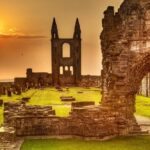
Mother Glasgow has a street-side sense of humor. On this 3-hour walking tour, Johnny (the self-styled Glasgow Gander) guides you through central Glasgow with a mix of standout architecture and the kind of quirky local stories that make the city feel personal fast, including a full-on Mother Glasgow explanation. You start at Royal Exchange Square and finish near Glasgow Cathedral, with an easy pace built for people who want to learn without running.
I like how this tour keeps it small (up to 15), so you actually hear the guide and you’re not just a head in a crowd. I also love the way the stops connect—cone-wearing history by the Duke of Wellington, the symbolic heart of George Square, then right on through Tron Kirk Steeple, Tolbooth Steeple, and ending at Glasgow Cathedral with the Necropolis in view. You’ll even get practical add-ons like pub and food recommendations, plus little perks during the walk.
One thing to consider: this is mostly outdoors, so plan for cold or rain, and note that cathedral time can be affected by COVID-related group limits or mask rules (so the tour may finish outside).
In This Review
- Key highlights you’ll feel right away
- Starting at Royal Exchange Square: the vibe and the pacing
- Why the small-group limit (15) makes a difference in Glasgow
- Mother Glasgow: the tour’s idea of the city in one character
- The Duke of Wellington cone story: Glasgow’s sense of mischief
- George Square and Glasgow City Chambers: civic Glasgow’s center stage
- The Georgian Glasgow stop: an overlooked side of the city
- “Mother Glasgow” in action: growth, decline, renaissance
- Trongate: Tron Kirk Steeple and the story of a grotty entertainment venue
- Tolbooth Steeple and Glasgow Cross: old Glasgow at ground level
- St Mungo at High Street and the street-art moment you’ll remember
- Provand’s Lordship and the blue inter-dimensional building
- Glasgow Cathedral with the Necropolis behind: medieval awe meets Victorian drama
- What you gain after the walk: tips you’ll actually use
- Value for $16.64: why the price makes sense for a 3-hour story walk
- Who this Glasgow walk suits best
- Should you book the Gander Walking Tours in Glasgow?
- FAQ
- How long is the Gander walking tour in Glasgow?
- How much does the tour cost?
- How big is the group?
- Where does the tour start and end?
- What language is the tour offered in?
- Do I need to buy admission tickets for stops?
- Is there a mobile ticket?
- Can I cancel for a full refund?
- Are service animals allowed?
Key highlights you’ll feel right away
- Small-group format (max 15) so the pace stays relaxed and the guide can tailor answers
- Johnny’s Mother Glasgow storyline tying architecture, industry, and identity together
- A route that mixes big sights with oddball details like the cone-wearing Duke of Wellington tradition
- Stop-by-stop “what to notice” moments (including Glasgow City Chambers and the rooftop ship)
- Free-to-see landmarks with no add-on admissions baked into the route
- Real local follow-up tips after the walk, including places to eat and drink
Starting at Royal Exchange Square: the vibe and the pacing
You meet in central Glasgow at Royal Exchange Square (8–10 Royal Exchange Square, G1 3AB), with the tour starting at 10:30 am. The end point is Glasgow Cathedral (Castle St side), so it’s built for a one-way walk that gradually shifts from civic buildings into the medieval center of the city.
The pace is aimed at people who want to learn without sprinting. Each stop is short—often around 5 to 10 minutes—so you’re constantly moving, but you’re not stuck for long stretches at one spot. This matters because the best city walks don’t just show you places; they teach you what to look for, and you only retain that if you can keep your momentum.
Other walking tours we've reviewed in Glasgow



Why the small-group limit (15) makes a difference in Glasgow
When a walking tour caps at 15 people, a lot of things improve at once. You’re more likely to hear the guide clearly. You’re less likely to get lost in a photo line. And the guide has enough breathing room to check in with you and adjust the pace.
On this one, that personal feel shows in the way Johnny keeps the tour lively and story-driven rather than lecture-y. In reviews, people highlight that he learns names and keeps the group comfortable—even on cold days—and that he’s careful about not disturbing businesses or locals when the route includes spots near shops and venues. That’s the kind of small operational detail that makes the walk feel smooth instead of chaotic.
Mother Glasgow: the tour’s idea of the city in one character

The story begins with a landmark stop where you’re introduced to Mother Glasgow, Scotland’s powerhouse—billed through a persona called the Glasgow Gander. The point isn’t just trivia. It’s a framework for understanding what you’re seeing next.
If you’ve ever looked at a city and wondered why the buildings look the way they do, this helps. Mother Glasgow becomes the thread connecting Glasgow’s growth into a commercial and then industrial powerhouse, its decline, and a later renaissance. When you reach the civic and religious landmarks afterward, the tour helps you see them as more than postcard backdrops—they’re outcomes of the city’s economic swings and self-invention.
And the tone matters too. Johnny’s humor and local voice keep the “big picture” from getting heavy. You’ll leave with a mental map that’s emotional as well as geographic.
The Duke of Wellington cone story: Glasgow’s sense of mischief
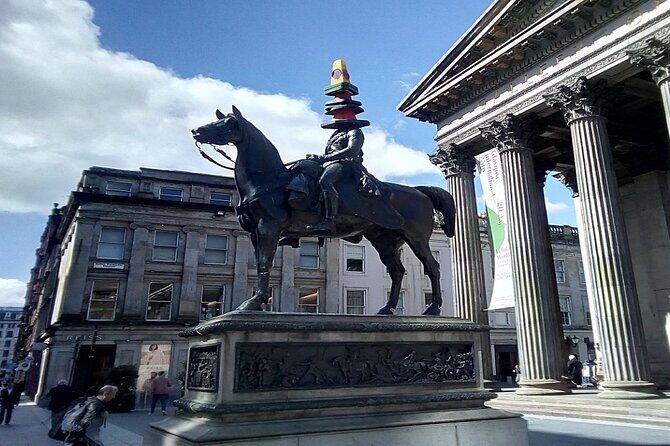
One of the early stops is the Duke of Wellington Statue. It’s quick—around 5 minutes—but it’s memorable because it explains a tradition tied to the commander’s cone-wearing look.
The story here is the kind of detail Glasgow does well: small, odd, and specific. It’s also a useful trick for walking tours. When you learn one quirky fact early, you start noticing the city’s personality everywhere—down to the way people name things, protect traditions, and build humor into everyday landmarks.
If you like your history with a wink, this is your opener.
George Square and Glasgow City Chambers: civic Glasgow’s center stage

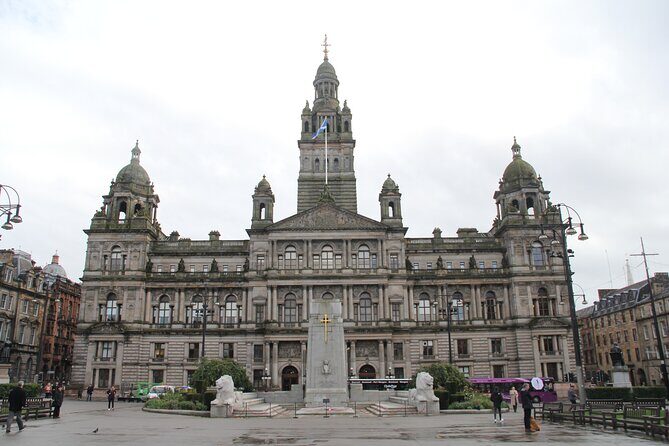
Then you move to George Square, Glasgow’s symbolic heart. The stop is about 10 minutes and includes a few things that are easy to miss if you’re walking alone.
- You’ll circle key viewpoints that point you toward Glasgow City Chambers, one of northern Europe’s finest civic buildings.
- You’ll also get a quirky spotting task: watch for a rooftop ship that can do unpredictable movement behavior.
That rooftop detail is exactly the kind of “only in this city” moment that makes George Square more than a junction. Even if you’ve seen photos, the tour helps you connect the building’s role to the city’s identity—civic pride shaped in stone, not just in speeches.






The Georgian Glasgow stop: an overlooked side of the city
Next comes a stop centered on an often-overlooked corner of Georgian Glasgow. This segment leans into the contrast between what visitors expect (big Victorian drama and church spires) and what the city actually built earlier.
You’ll also hear a story about a club where pig-like gluttony was encouraged. It’s a weird detail, and that’s the point. Glasgow isn’t only grand or grim—it’s also social, competitive, and oddly playful. Learning about how people behaved in specific historical settings makes the later industrial story feel more human.
Heads-up for your attention span: this stop is short, but you’ll probably want to look around once you’re told what to notice. That club story lands best when you pair it with what’s physically around you.
“Mother Glasgow” in action: growth, decline, renaissance
Another key stop (in the shadow of striking central buildings) expands the Mother Glasgow theme into the full timeline: commercial growth, industrial rise, decline, renaissance, and Mother Glasgow’s ongoing impact beyond Scotland.
This part is where the tour becomes more than a sequence of sights. It gives you a narrative backbone that helps you understand why Glasgow looks like it does today, including why it has both historic grandeur and signs of reinvention.
If you like to travel with a purpose—like learning the city’s “why”—this is the section that will stick with you on your metro rides later.
Trongate: Tron Kirk Steeple and the story of a grotty entertainment venue
Trongate is one of those street names that sounds straightforward until you’re standing right there and realize it’s loaded with layered history. You spend about 10 minutes here, near the 16th century Tron Kirk Steeple.
The tour’s focus: an incredible hidden entertainment venue story, described as being in full glory and grottiness. That phrase matters. It’s not about polishing the past. It’s about showing Glasgow’s older entertainment culture as it actually was—working-class, lively, and a little rough around the edges.
Practical takeaway: you’ll likely start scanning doorways, stair entries, and street-level shapes differently after this stop. That’s a real benefit of guided walking tours—you learn how the city hides things in plain sight.
Tolbooth Steeple and Glasgow Cross: old Glasgow at ground level
Next is Tolbooth Steeple, under the 17th century steeple where multiple streets converge around Glasgow Cross. The stop is also about 10 minutes.
This segment is all about the epicentre feeling—Old Glasgow as the meeting point of movement, commerce, and civic life. If you want the city’s geography to make sense fast, Glasgow Cross is a strong place to learn it. It’s a natural “hub” moment in the walk where earlier stories about civic identity and social life start to click into place.
You’ll leave this stop with a clearer mental map of how the city’s center used to function and how it still echoes today.
St Mungo at High Street and the street-art moment you’ll remember
At St Mungo at High Street, the tour targets something easy to overlook: Glasgow’s most famous son hiding in plain sight, presented as one of the best pieces of street art you’ll ever see.
This stop is very short—about 2 minutes—but it’s built to do one thing: snap your eyes back to the human scale of Glasgow. Not everything here needs to be ancient stone. Sometimes the city’s best “history” is right on the surface, if you know where to look.
Provand’s Lordship and the blue inter-dimensional building
From there, you cross toward Provand’s Lordship, a 15th century house and the city’s oldest house. You take in a small cluster of four special buildings, including a small blue one that’s sometimes used in inter-dimensional travel jokes.
This is one of those tour segments that works even if you’re not a “history house” person. You get context (Provand’s Lordship’s age and role), and then you get permission to enjoy the playful local storytelling. It’s a reminder that Glasgow’s past isn’t preserved in glass—it’s lived around daily.
If you’re traveling with kids or you just like humor, this is a good pocket of the route.
Glasgow Cathedral with the Necropolis behind: medieval awe meets Victorian drama
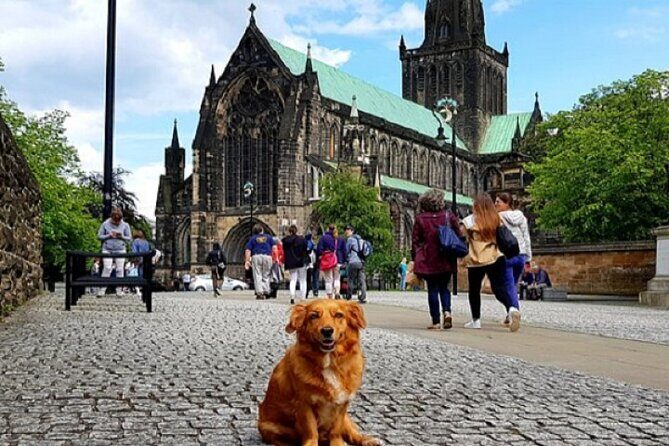
The final big landmark is Glasgow Cathedral, described as Glasgow’s architectural pinnacle—medieval, Scottish Gothic, and dramatic in its setting. You spend about 10 minutes here, and the backdrop is the Victorian Necropolis, sometimes called the city of the dead.
This stop is where the walk starts to feel like a destination. The cathedral’s architecture is meant to be seen with patience, even if your tour time is brief. If COVID rules affect group size or mask requirements, the tour may finish outside the cathedral rather than fully inside. Either way, you’ll still get the big-picture orientation.
Practical note: wear shoes you can stand in comfortably. Cathedral stops are short, but you’ll want to reposition for views.
What you gain after the walk: tips you’ll actually use
A big reason this tour stays at the top of people’s lists is that Johnny doesn’t treat the tour like a one-and-done sightseeing session.
In addition to the route, the experience includes:
- Practical insider recommendations sent afterward for museums, pubs, and other things to do
- Storytelling with extra touches like props and photographs passed around during key history moments
- The habit of giving people names and details attention, which makes the tour feel less scripted
- Small food or drink extras mentioned in reviews, including trying Irn Bru, plus pub suggestions like Step Bar
That post-tour list is where value really shows. You walk away with a plan for the rest of your day or your remaining time in Glasgow, not just a route you already completed.
Value for $16.64: why the price makes sense for a 3-hour story walk
At about $16.64 per person for an approximately 3-hour walk, you’re paying for two things: time and a skilled local guide.
You’re not being asked to stack paid admissions into the day. The stops you’ll hit are largely free to access, with “admission free” indicated for multiple stops. That means your cost stays predictable. And because the route covers many central points in a short window, you’re effectively buying a shortcut through guesswork.
Also, the tour is booked on average about 36 days in advance, which hints that it’s popular for a reason. If you’re going during peak travel dates, booking early is a smart move so you can lock in a time that matches your sightseeing rhythm.
Who this Glasgow walk suits best
This tour works best if you want:
- A first-timer-friendly introduction to Glasgow’s center
- Architecture with personality, not just facts
- A guided route that mixes major landmarks with smaller, story-driven stops
- A guide who’s enthusiastic and willing to share local picks for food and drink
It can also be a solid choice if you’re traveling with family. In reviews, people mention baby-friendly support and that bringing a stroller wasn’t an issue. Service animals are allowed too.
If you hate walking on uneven city sidewalks, or you need long seated breaks, you might find a 3-hour downtown walk a bit much. But if you’re ready to move and enjoy stories while you walk, you’ll likely have a good time.
Should you book the Gander Walking Tours in Glasgow?
I’d book this if you want a guided Glasgow that feels like it has a pulse—civic pride, industry ups and downs, and street-level humor all stitched together in one central route. The small group size is a major plus, especially if you want to actually hear the guide and enjoy the stop-by-stop details. The added follow-up recommendations (and little extras like Irn Bru) make it feel like you’re getting more than a basic checklist tour.
Before you go, do two simple things:
- Bring comfy walking shoes and dress for weather since you’ll spend a good chunk outside.
- Bring a pen or at least plan to save notes on your phone, because you’ll be given plenty of ideas for what to do next.
If your goal is to get your bearings fast and fall a little in love with Glasgow on day one, this tour is a strong bet.
FAQ
How long is the Gander walking tour in Glasgow?
The tour lasts about 3 hours.
How much does the tour cost?
The price is $16.64 per person.
How big is the group?
This tour has a maximum group size of 15 travelers.
Where does the tour start and end?
It starts at 8–10 Royal Exchange Square, Glasgow G1 3AB and ends at Glasgow Cathedral, Castle St side (inside Glasgow Cathedral on the north-west side of Glasgow City Centre).
What language is the tour offered in?
The tour is offered in English.
Do I need to buy admission tickets for stops?
The stops are listed as admission ticket free, meaning you typically aren’t paying separate entry fees for the sights included in the route.
Is there a mobile ticket?
Yes, a mobile ticket is included.
Can I cancel for a full refund?
Yes. You can cancel up to 24 hours in advance for a full refund.
Are service animals allowed?
Yes, service animals are allowed.